
GTA VI Wanted System Explained: Everything Confirmed So Far


Jason and Lucia’s criminal activity sits at the centre of GTA VI’s more detailed police response. Source: Rockstar Games.
GTA VI is bringing back a six-star wanted scale, but the bigger change is how police appear to build information about the player. Rockstar’s Extended Look shows a system that tracks more than a simple star count, while comments from Rockstar North co-studio head Rob Nelson explain how witnesses, vehicles, appearance and whether Jason and Lucia are together can affect a pursuit.
This guide covers only what Rockstar has shown or directly explained. Features commonly discussed online — such as exact military responses, roadblock rules or arrest penalties — remain unconfirmed unless Rockstar says otherwise.
GTA VI wanted system at a glance
• Maximum wanted level: Six stars are visible in official footage.
• Crime reporting: A witness or alarm appears to be required before a crime is reported.
• Police knowledge: Officers can gain information about your face, clothes, vehicle and whether Jason and Lucia are travelling together.
• Evasion: Changing vehicle or splitting up can reduce what police know about the suspects.
• Separate system: A Criminal Profile layer appears alongside the immediate Wanted system.
Crimes need to be reported
One of the most important differences is that committing a crime does not automatically mean every officer instantly knows about it. Rob Nelson has explained that a witness or an alarm is needed for the crime to be reported, which gives the player a clearer connection between what happens at the scene and the police response that follows.
That makes witnesses and the environment more meaningful. A robbery in a quiet area could play differently from the same crime in a crowded public space, although Rockstar has not yet explained every possible reporting condition.
The six-star scale is back
The Extended Look visibly shows six wanted stars, restoring the maximum scale associated with older Grand Theft Auto games. That confirms the star count itself, but Rockstar has not yet detailed what each individual level changes or what units appear at the highest stages.
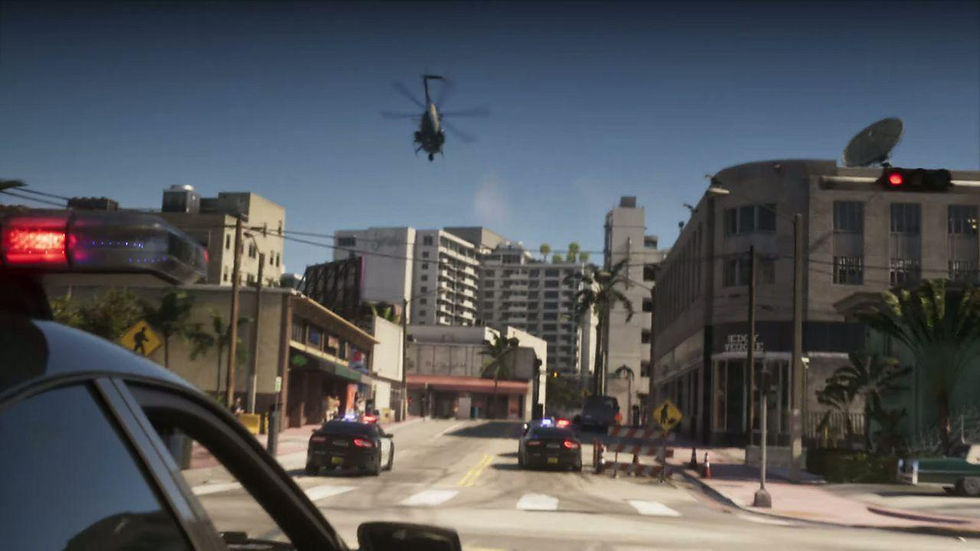
Police activity over Vice City in in-game PS5 footage. Source: Rockstar Games.
Police can build a description of you
The most significant change is the information displayed around the pursuit. Rockstar’s footage and Nelson’s comments indicate police can know details such as the suspects’ faces, clothing and current vehicle. The system can also recognise that Jason and Lucia are travelling as a pair.
This means the Wanted meter is not simply an on-or-off state. The police appear to hold specific pieces of information about who they are looking for and what they are driving, which creates more ways for the player to change the situation.
Changing vehicles and splitting up can matter
If the police know the vehicle being used, switching cars can reduce that part of the identification. Nelson also explained that Jason and Lucia separating can lower police perception because officers are no longer searching for the pair together in the same way.
The Extended Look supports this more physical approach to evasion by showing car theft tools, vehicle changes and police chases that continue beyond the initial crime scene.

A high-speed vehicle sequence from Rockstar’s in-game PS5 Extended Look. Source: Rockstar Games.
Losing sight of the police is only part of escaping
Official footage suggests there is a difference between being actively seen and still being a known suspect. A player can reduce immediate police perception while information about the suspect or vehicle remains relevant. Rockstar has not yet published a full ruleset for how long that information persists, so any exact timers currently circulating should be treated as unconfirmed.
Criminal Profile is separate from Wanted
The Extended Look also shows a Criminal Profile indicator around the HUD. Nelson has compared the broader idea to systems Rockstar has used before, but GTA VI appears to frame it around how the player behaves as a criminal rather than a simple good-versus-bad morality meter.
For now, the safest interpretation is that Wanted represents immediate law-enforcement attention, while Criminal Profile tracks a broader pattern of behaviour. Rockstar has not fully explained the long-term consequences of that profile.
What remains unconfirmed
• Six-star response: The maximum star count is confirmed, but the exact police or military units used at six stars are not.
• Roadblocks and spike strips: Possible, but not fully detailed by Rockstar.
• CCTV mechanics: No complete official explanation has been published.
• Arrest and fine penalties: Rockstar has not explained the final arrest system or financial consequences.
• Exact memory duration: We do not yet know precisely how long police retain suspect, clothing or vehicle information.
Frequently asked questions
How many wanted stars are in GTA VI?
Official GTA VI footage shows a six-star maximum.
Do police instantly know when you commit a crime?
Not necessarily. Rockstar says a witness or alarm is needed for the crime to be reported.
Can police identify your car?
Yes. Rockstar has shown and discussed police knowing the vehicle connected to the suspects.
Can changing clothes or cars help?
Police can track clothing and vehicle information, so changing identifying details can affect what officers know. The precise limits of each tactic are still being clarified.
Is Criminal Profile the same as Wanted level?
No. They appear to be separate systems: Wanted covers immediate police attention, while Criminal Profile is a broader behavioural layer.


Comments